Related Books:
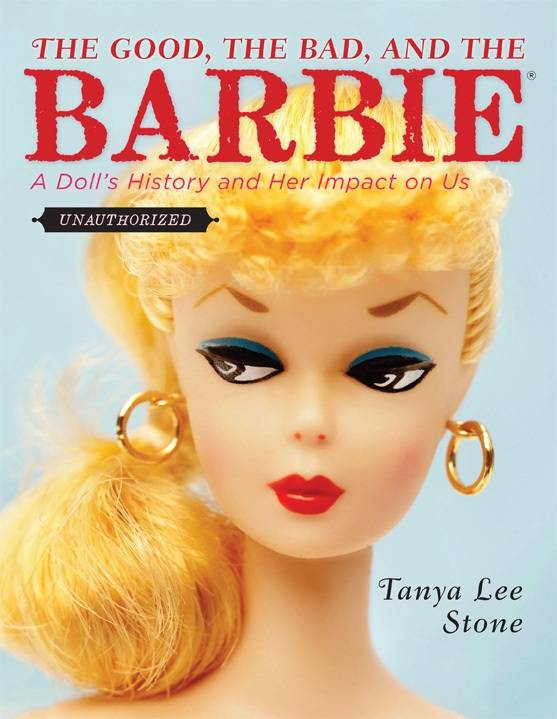
The Good, the Bad, and the Barbie
Viking Children's Books | 2010 | 10 and up
ABOUT THE BOOK:
The Good, the Bad, and the Barbie
A Doll's History and her Impact on Us
Foreword by Meg Cabot
Barbie just might be the most famous doll in the world. She’s represented fifty different nationalities. She’s stepped into the always-fashionable shoes of more than one hundred careers. She has been played with, studied, celebrated, and vilified for more than fifty years. And she has unquestionably influenced generations of girls—whether that influence has been positive or negative depends on who you ask.
When award-winning author Tanya Lee Stone started asking girls, boys, men, and women how they feel about Barbie, the first thing she discovered is how passionate people are about her. Here are a few things they said:
"Barbie is really only a reflection of the girl holding her. My generation of 'Barbie girls' is now entering the world and we seem to be doing just fine." --Sara, age 17
"Barbie, I hate you!" --Luci, age 15
"How Barbie looked was never the issue. Not to the girls who loved her. It was what she taught us that mattered. And what she taught us was that, like Barbie, we could be anything we wanted to be." --Meg Cabot
"Barbie has been the #1 most destructive force on the self-image of women all over the globe!" --Dr. Carole Lieberman
The Good, the Bad, and the Barbie is part biography—both of the doll and of her inventor, Ruth Handler—and part exploration of the cultural phenomenon that is Barbie. Filled with personal anecdotes, memories, and opinions from people of all ages, and featuring original color and black and white photographs, this book is for anyone who understands that we’re all living in a Barbie world.
AWARDS & REVIEWS:
Winner of The Golden Kite Award!
Lauren Myracle: "Holy belly buttons! This is no mere Barbie book. This is a how-to manual about being a girl!"
E. Lockhart: "History writers don't get better...balanced, funny, provocative --important for anyone wanting to understand girlhood in America."
Jess Weiner: "Love Barbie or hate her, what I admire about Tanya's book is that she takes an even eye to Barbie's global phenomenon and delicately lets readers explore their own complicated relationships to this very complicated doll."
Reviews
Kirkus (starred): "Sibert Medalist Stone tantalizes with her brief and intriguing survey of Barbie. She begins with the history of Mattel, started by self-made businesswoman Ruth Handler in the 1940s, and moves onto materialism, body image, portrayals of ethnicity, nudity, taboo and art. Direct quotes from women and girls showcase the variety of feelings that Barbie engenders, and the author weighs in occasionally and effectively to show that though Barbie is often "just a doll...We have...helped make her the icon-and subject of controversy-that she is." That authorial "we" often wavers between a universal and one that is clearly adult, and she herself suggests that adults are most concerned with Barbie as an idea, while kids engage with her as a doll, indicating an audience of teens and adults rather than children. The striking cover, open design with numerous photographs and collegial voice will appeal to younger readers, though, and if they overhear something of a conversation pitched to adults, they'll just take it as they can use it--as they already do with Barbie. (author's note, source notes, bibliography, index) (Nonfiction. 11 & up)"
School Library Journal (starred): "In the prologue, Meg Cabot describes her desire for a Barbie and her mother's reluctance to purchase one, basically summing up the conflict surrounding the doll since its introduction in 1959. Readers learn about Mattel Toys and the background behind Barbie's concept and development, how it was a solution for girls who wanted to imagine adult roles rather than just play mother, and details about inventor Ruth Handler. But more than that, Stone reveals the pathos behind so many relationships of girls with Barbie: those who cherished her and those who were negatively influenced. Was she a destructive role model or just a toy? Experts disagree. In this balanced overview, both sides of the quandary are addressed. Barbie's different roles, graduating from nurse to surgeon, stewardess to pilot, and always a woman of her own means, reflect societal changes over the past 50 years as well. Numerous black-and-white photos feature the doll in her various incarnations, while eight center pages deliver color versions as well as images of Barbie-inspired art. Inset quotes appear on a Barbie handbag icon. The author maintains her signature research style and accessible informational voice and includes extensive source notes and bibliographical information." -Janet S. Thompson, Chicago Public Library